HOUSE SHOWINGS AND THE CORONAVIRUS

Is great access to the Edmonton International Airport important to you? Do you want to live near the edge of the city in an attractive, single-family home neighbourhood (about 10 percent is duplexes)?
If so, take a look at Rutherford in south Edmonton. This community, named after Alberta's first premier, Alexander Cameron Rutherford, used to be farmland. It will soon be surrounded on all sides by quality residential development, with easy access to Anthony Henday Drive (Edmonton’s Ring Road) and Highway 2 (Queen Elizabeth II Highway, running south to Calgary).
Rutherford hasn’t lost its connection to the natural habitat, preserving it with a series of tranquil parks -- including the Virginia Park Woodland -- that dot the neighborhood.
Rutherford is bounded on the west by 127 Street, on the east by James Mowatt Trail (111 Street), on the north by Ellerslie Road and on the south by Blackmud Creek Ravine, with a line connecting the ravine to 127 Street near 25 Avenue SW.

1. A wave of new buyers.
Spring brings an enormous wave of new buyers into the marketplace, looking for homes. These are both first-timers – many of them Millennials – and people re-sizing (either up or down as their families grow or the nest empties). They come out of hibernation on a Spring mission to upgrade their lifestyles, putting in long hours in the sunshine, looking for their next perfect home. If you’ve had your property on the market for a while, this makes it a whole new game and your best chance to close a sale. If you’ve been thinking of listing, price it right and do it now.
2. Homes show better.
With the extended daylight hours and warmer temperatures, snowbanks melt and the landscape gets greener. Because of this, homes simply “show better” in the Spring. To stage for the season, try adding flowerboxes and plants around your front entrance (see our next article for a grower’s head-start). Without question, planters can make your home more appealing to prospects. Give your property a thorough Spring cleaning. Minimize clutter and let some of the outdoors into your home, if possible. Everything should look bright and fresh, including your chances for a sale.
3. Prices spike and often peak.
This could be because people get money back from Revenue Canada in April/May. It might be because they’re more inclined to spend large sums of money during the invigorating Spring season of renewal. Or, most likely, it’s because of the wave. With more people out looking for a home in the Spring, there’s more competition for homes and a much greater sense of urgency. Heightened demand can lead to bidding wars that drive up prices.
4. Days on Market gets shorter.
As days get longer, time to sell gets shorter! Historically, homes sell faster during the Spring months than most other times of year. With more people out looking (and for more hours every day), they’re often seeing each other at showings. To avoid being out-bid on “perfect homes,” buyers tend to make their offers – and close on their purchases – faster in the Spring. Quick sales and higher sale prices tend to happen together at this time of year.
5. Moving is more fun.
If you have children in school, finding a new home in the Spring means you’ll probably be moving into it after the school year ends. A move during the more leisurely days of summer is simply more relaxing. It can even be fun. Fall and winter moves, by contrast, can coincide with horrendous weather, making it a miserable proposition. And even though we have Spring blizzards in Western Canada, the snow usually melts quickly and moves are more manageable.


Consumer Electronics Show (CES) is the world's biggest tech show held in Las Vegas last January showcasing the latest and upcoming innovations from artificial intelligence, robotics, gadgets, and much more. We are highlighting a few of the best smart home tech that were featured in the event in our photo gallery. These gadgets are not only cool but are useful and provide benefits for consumers at home.


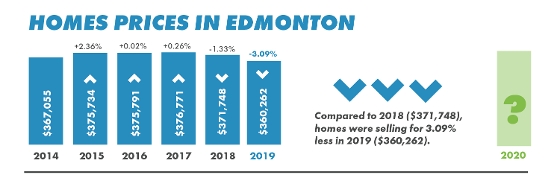
Home Prices
The results are in. The 2019 home price for Edmonton, based on sales, was $360,262. That was down 3.09 percent from $371,748 in 2018. Looking back, the price rose for three straight years from $367,055 in 2014 to $376,771 in 2017 before a weakened economy drove markets down slightly in 2018 and 2019. It’s difficult right now to predict what’s going to happen next. Some experts believe we’re at the bottom of the market (a great time to buy)! What do you think Edmonton’s home price will be in 2020?

Sold vs New Listings
With 16,557 Edmonton homes sold last year, 2019 was the worst-performing year in the last six. When sales volume is low and supply grows due to new listings, we typically call it a buyer’s market. If you’re selling, you might need to wait for a while before you find a buyer and then you might get a lower offer than what you’re hoping to see. Despite fewer sales in 2019, supply was also lower, tempering this dynamic. The sold-to-listings ratio actually rose by several percentage points.
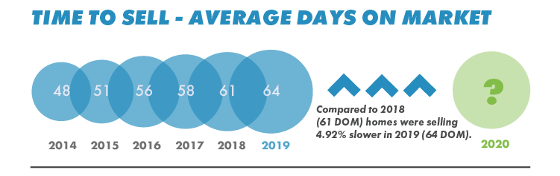
Time to Sell – Average Days on Market
For five years in a row in Edmonton, the Time to Sell has risen. In 2019, it took an average 64 days (more than two months) to sell a property. In 2014, when sales volume was higher and there were fewer listed properties to choose from, that number was 48 days. If you’re buying in Edmonton, the last few years of lower sales and higher supply have meant there’s been plenty to look at. If job growth and other factors improve, we could see that situation change, with lower supply and faster sales. What do you think is going to happen in 2020?

Market Distribution
Look at the infographic and you’ll see that the vast majority of Edmonton’s home sales activity for 2019 occurred at prices below $800,000. The highest volume (3,596 sold) was in the $300,000 to $399,999 price range. Five properties were purchased for $2-$3 Million. Only two sold for more than $3 Million last year.